
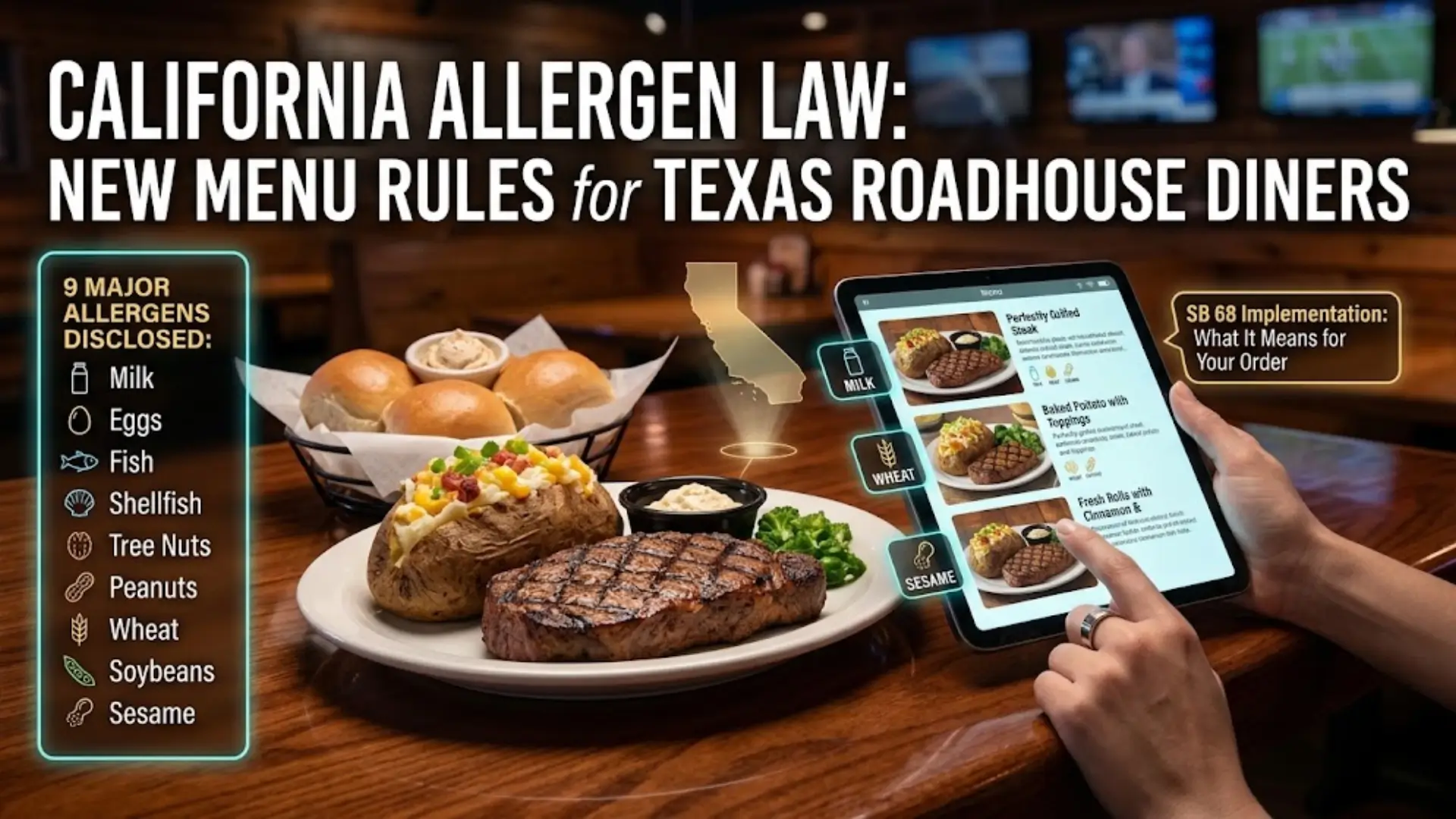
The Texas Roadhouse California allergen law is part of a major change in how qualifying restaurants disclose food allergens to customers. California Senate Bill 68, also known as the Allergen Disclosures for Dining Experiences law, requires covered restaurant chains to provide written information about major food allergens contained in their standard menu items. The new disclosure requirement began July 1, 2026.
For Texas Roadhouse customers in California, the change is mainly about access to allergen information when ordering. It does not mean Texas Roadhouse is banning certain ingredients, eliminating popular dishes, or becoming an allergen-free restaurant.
Texas Roadhouse has California locations, including restaurants in National City, El Cajon, Rialto, Corona, Tracy, Fairfield and Fresno, and its official website provides menu and location information.
Here is what California’s new allergen law means for Texas Roadhouse diners, what information restaurants must provide, which allergens are covered, and why customers with food allergies should still communicate directly with restaurant staff.
What Is the Texas Roadhouse California Allergen Law?
There is not a separate allergen law written specifically for Texas Roadhouse.
The phrase “Texas Roadhouse California allergen law“ refers to California’s Senate Bill 68 (SB 68) and how that statewide requirement applies to qualifying chain restaurants such as Texas Roadhouse.
SB 68 amended California’s Retail Food Code and created a new requirement for covered food facilities. Beginning July 1, 2026, qualifying restaurants must provide written notification of major food allergens that the facility knows or reasonably should know are contained as ingredients in each menu item.
The law was signed by Governor Gavin Newsom in October 2025 and was described by its author, Senator Caroline Menjivar, as the first state law of its kind requiring allergen disclosures on restaurant menus.
The Important Date
There are two dates worth understanding:
- January 1, 2026: SB 68 became effective as California law.
- July 1, 2026: The new restaurant allergen-disclosure requirement began.
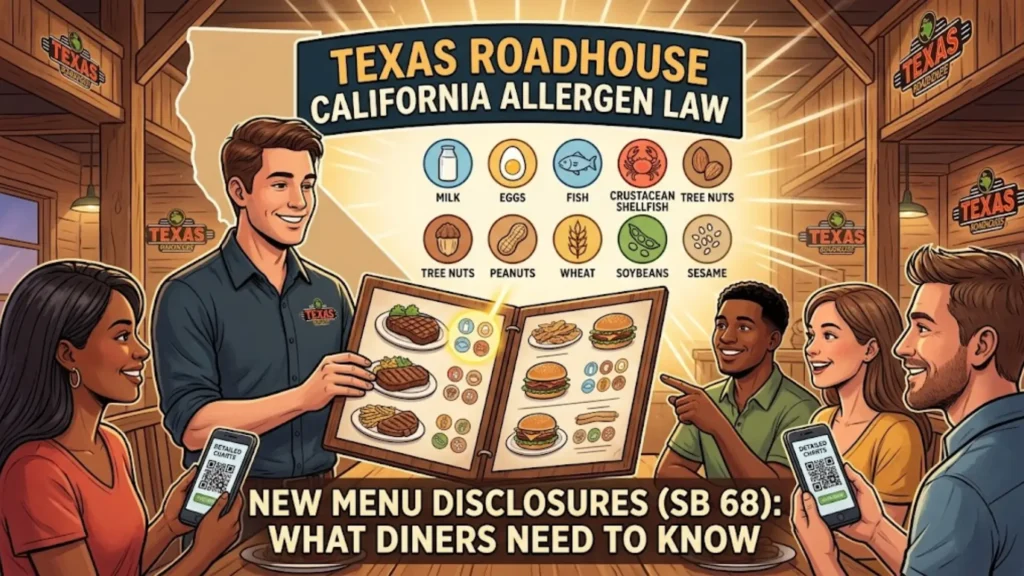
Therefore, customers searching for the Texas Roadhouse California allergen law in September 2026 are looking at a requirement that is already in effect.
Does the New Law Apply to Texas Roadhouse?
Texas Roadhouse is a large restaurant chain with numerous locations operating under the same name and substantially similar menus.
California’s law applies to food facilities covered by the federal restaurant menu-labeling provisions, which generally cover chain restaurants with 20 or more locations operating under the same name and offering substantially the same menu items.
Texas Roadhouse has multiple locations throughout California and operates as a national restaurant chain. Its official website currently lists California locations and provides access to menu information.
That means qualifying Texas Roadhouse locations in California must comply with the applicable SB 68 disclosure requirements.
The important point is that SB 68 applies because of the restaurant’s status as a covered chain, not because California created a law specifically targeting Texas Roadhouse.
What Does California’s Allergen Law Require?
The core requirement is straightforward.
A covered restaurant must provide written notification of the major food allergens it knows or reasonably should know are present as ingredients in each standard menu item.
Restaurants can provide this information in different ways.
For example, allergen information can be provided:
- Directly on the menu
- Through a digital menu
- Through a QR code
- Through an allergen-specific menu
- Through an allergen chart
- Through an allergen grid
- Through an allergen booklet
- Through other written materials that satisfy the requirements
If a restaurant uses a digital format, California law also requires an alternative method for customers who cannot access the digital information.
This is particularly important because an allergen disclosure system should not depend entirely on a customer’s ability to use a smartphone.
Which Allergens Must Texas Roadhouse Disclose?
California’s law recognizes nine major food allergens.
They are:
- Milk
- Eggs
- Fish
- Crustacean shellfish
- Tree nuts
- Peanuts
- Wheat
- Soybeans
- Sesame
The addition of sesame is significant because SB 68 specifically added sesame to California’s list of major food allergens.
Why Sesame Matters
Sesame is now included alongside the other major allergens for purposes of California’s restaurant disclosure requirement.
For diners with sesame allergies, this means qualifying restaurants must account for sesame when determining the allergen information associated with covered menu items.
Does the Law Require Texas Roadhouse to Change Its Recipes?
No.
SB 68 is primarily a disclosure requirement.
The law does not generally tell Texas Roadhouse that it must remove milk, wheat, eggs, soy, sesame or other allergens from its recipes.
Instead, it requires covered restaurants to disclose major allergens they know or reasonably should know are ingredients in their menu items.
That distinction is important.
A steak, appetizer, side dish, dessert or other menu item can continue to contain an allergen. The restaurant’s obligation is to provide the required information so customers can make more informed ordering decisions.
Does Texas Roadhouse Become an Allergy-Free Restaurant?
No.
The California allergen law does not mean Texas Roadhouse restaurants are allergen-free kitchens.
A disclosure requirement and an allergen-free preparation environment are two different things.
Texas Roadhouse serves a broad menu containing many different ingredients. Its official menu includes steaks, ribs, chicken, burgers, salads, sides, desserts and other dishes.
Because multiple foods are prepared in the same restaurant environment, customers with serious food allergies should continue to communicate their allergy clearly to restaurant staff.
California’s Department of Public Health specifically warns that cross-contact can occur when restaurants use the same utensils, cutting boards, gloves or other equipment for allergenic and non-allergenic foods.
What Is the Difference Between an Ingredient and Cross-Contact?
This is one of the most important issues for allergy-conscious diners.
The new law concerns major allergens that are known or reasonably should be known to be contained as ingredients in menu items.
Cross-contact is different.
Cross-contact can occur when an allergen unintentionally comes into contact with another food during preparation, cooking or handling.
For example, equipment used to prepare a food containing wheat, milk or another allergen could potentially come into contact with another dish.
California Department of Public Health guidance specifically recommends that consumers ask food handlers about allergens and potential cross-contamination when ordering restaurant food.
Therefore, an allergen disclosure should not automatically be interpreted as a guarantee that a meal is completely free from accidental allergen exposure.
Can Customers See Allergen Information on a Texas Roadhouse Menu?
The law gives qualifying restaurants flexibility in how they present the information.
A restaurant can place allergen information directly on its menu or use a digital system, including a QR code that leads customers to a digital menu. It can also use alternative written materials such as an allergen chart, grid or booklet.
Texas Roadhouse’s official website has a dedicated Nutrition & Allergens section within its corporate site, indicating that nutrition and allergen information is part of the company’s customer-information resources.
However, customers should check the information available for the specific restaurant and current menu item rather than relying on an old screenshot, third-party allergen chart or social-media post.
What Does “Knows or Reasonably Should Know” Mean?
This wording is important because the law does not require a restaurant to make impossible guarantees.
SB 68 requires disclosure of major food allergens that the covered food facility knows or reasonably should know are contained as ingredients in each menu item.
In practical terms, restaurants need systems and ingredient information that allow them to identify applicable major allergens in their standard menu items.
This does not mean restaurants are required to predict every possible accidental contamination event.
Can Allergen Information Be Provided by QR Code?
Yes.
California’s law expressly allows covered food facilities to provide allergen information digitally, including through a QR code linked to a digital menu.
This gives restaurants flexibility while still making allergen information available at the time customers are making ordering decisions.
However, customers who cannot access digital information must have an alternative method available when the restaurant chooses the digital approach.
What If a Customer Does Not Have a Smartphone?
A restaurant cannot rely exclusively on digital access if doing so would leave customers without the required allergen information.
California’s SB 68 provides for alternative methods when a restaurant uses a digital format.
Examples include:
- A separate allergen menu
- An allergen chart
- An allergen grid
- An allergen booklet
- Other written materials
This allows diners without smartphones or with difficulty accessing digital information to obtain the relevant allergen disclosures.
Does the Law Apply to Every Texas Roadhouse Menu Item?
The law focuses on menu items and the applicable restaurant requirements.
There are also exemptions under the law and the federal provisions it references.
For example, California’s Department of Public Health explains that certain limited-time menu items can fall outside the federal standard-menu requirements when they are offered for a sufficiently limited period or for testing consumer acceptance.
The law also does not apply to prepackaged foods subject to federal allergen-labeling requirements in the same way, and it excludes certain compact mobile and nonpermanent food facilities.
For a Texas Roadhouse customer, the practical takeaway is to focus on the restaurant’s standard menu and current allergen information rather than assuming every temporary promotion is covered in exactly the same way.
What Should Customers With Food Allergies Do at Texas Roadhouse?
The new law provides useful information, but customers should still take personal precautions.
Tell the Server About the Allergy
Do not simply say that you are “avoiding” an ingredient.
Clearly explain that you have a food allergy and identify the specific allergen.
Review the Allergen Information
Check the restaurant’s current allergen information before ordering.
Look for the major allergens associated with the specific menu item.
Ask About Preparation
If you have a severe allergy, ask whether the item is prepared using shared equipment or surfaces that could create cross-contact.
Confirm Substitutions
Changing a side dish, sauce, topping or dressing can change the allergen profile of a meal.
Ask whether the substitute contains any of the major allergens.
Do Not Rely on Old Online Lists
Restaurant recipes, suppliers and preparation methods can change.
An unofficial allergen chart posted online may not reflect the current menu.
What Are the Nine Major Allergens Under California Law?
For quick reference, California’s current list includes:
| Major allergen | Examples |
|---|---|
| Milk | Dairy ingredients |
| Eggs | Egg-containing ingredients |
| Fish | Cod, bass and other fish |
| Crustacean shellfish | Crab, lobster, shrimp |
| Tree nuts | Almonds, walnuts, pecans |
| Peanuts | Peanuts and peanut-derived ingredients |
| Wheat | Wheat-containing ingredients |
| Soybeans | Soy-containing ingredients |
| Sesame | Sesame-containing ingredients |
California Department of Public Health identifies these nine major allergens under SB 68.
The list should not be interpreted as meaning these are the only foods capable of causing allergic reactions. Many other foods can cause allergies, but these are the major allergens covered by the law.
Does the California Law Protect Customers From Cross-Contamination?
Not completely.
This is a common misunderstanding.
SB 68 improves allergen disclosure, but it does not transform restaurant kitchens into allergen-free environments.
California’s Department of Public Health specifically notes that cross-contamination or cross-contact can happen through shared utensils, cutting boards, gloves and other food-handling equipment.
The law also expressly states that its disclosure requirements do not eliminate other duties a food facility may have under existing law to reasonably ensure customer safety.
For people with severe food allergies, disclosure and communication should therefore be viewed as two parts of the same safety process.
Does This Law Mean Texas Roadhouse Is Being Fined or Investigated?
There is no basis in the California law itself to say that Texas Roadhouse is being targeted by a special investigation.
SB 68 is a statewide requirement that applies to qualifying food facilities.
California’s Department of Public Health explains that enforcement agencies can verify compliance by checking allergen disclosures on printed or digital menus and through other reasonable methods.
Therefore, a restaurant’s compliance obligation should not be confused with an allegation that the restaurant has violated the law.
Why Did California Create the New Allergen Rule?
The law was created to give consumers more information when eating outside the home.
Senator Caroline Menjivar, who authored SB 68, said the law was intended to provide greater transparency and safety for people with food allergies. Her office stated that millions of Californians live with food allergies.
Restaurant allergy information can be especially important because consumers may not know every ingredient used in a dish or every component of a sauce, seasoning, dressing or prepared side.
The law is therefore designed to make important allergen information easier to access before customers make an order.
How Is the New Rule Different From Nutrition Information?
Nutrition information and allergen information are related but different.
Federal and California menu-labeling rules already require qualifying chain restaurants to provide certain nutritional information for standard menu items.
SB 68 adds a separate requirement concerning major food allergens.
For a customer, this means a menu may provide information such as calories while also providing allergen information under the new California requirement.
Knowing the calorie count of a meal does not tell a customer whether the meal contains wheat, milk, eggs, sesame or another major allergen.
Does SB 68 Change the Texas Roadhouse Menu Nationwide?
No.
California’s law is a California requirement.
It applies to qualifying food facilities operating in California and does not automatically impose the same disclosure format on every Texas Roadhouse restaurant in every state.
A Texas Roadhouse location in California may therefore have allergen disclosure requirements that differ from a location in another state.
That does not necessarily mean the ingredients or recipes are different. The difference can simply be the information that California law requires the restaurant to provide to customers.
Will Texas Roadhouse Remove Foods Because of the Law?
There is no general requirement in SB 68 for Texas Roadhouse to remove foods containing major allergens.
The law is about disclosure, not banning allergens from restaurant recipes.
A restaurant can continue serving foods containing milk, wheat, eggs, soy, peanuts, tree nuts, sesame, fish or shellfish as long as it complies with applicable food-safety and disclosure requirements.
Customers should therefore be cautious about headlines or social-media posts claiming that California’s allergen law automatically means Texas Roadhouse is removing popular dishes.
What Should Diners Expect When Ordering?
For customers visiting a qualifying Texas Roadhouse location in California, the biggest practical change is improved access to allergen information.
Depending on how the restaurant implements the requirement, diners may encounter:
- Allergen information next to menu items
- An allergen chart
- An allergen booklet
- A digital allergen menu
- A QR code
- Other written allergen information
The exact presentation can vary because the law gives restaurants more than one compliant method.
What If the Allergen Information Appears Incorrect?
If a customer believes allergen information is missing or incorrect, the first step should be to speak with the restaurant and ask for clarification.
For serious allergies, do not proceed with an order if the ingredients or preparation method cannot be established with reasonable confidence.
Consumers can also contact the appropriate local food-safety or health authority when they have concerns about compliance.
California’s Department of Public Health provides information and contact resources for its Food and Drug Branch Retail Food Program.
What Texas Roadhouse Customers Should Remember
The new California allergen law can make restaurant ordering easier to understand, but customers still need to be proactive.
The most important points are:
- SB 68 is a California statewide law, not a Texas Roadhouse-specific law.
- The restaurant allergen disclosure requirement began July 1, 2026.
- Covered chain restaurants must disclose major allergens they know or reasonably should know are ingredients in menu items.
- California recognizes nine major allergens, including sesame.
- Allergen information can be provided on physical menus or digitally.
- QR-code and digital systems can be used when accompanied by an appropriate alternative method.
- The law does not require Texas Roadhouse to eliminate allergenic ingredients.
- The law does not make Texas Roadhouse restaurants allergen-free.
- Cross-contact remains a potential concern.
- Customers with serious allergies should communicate directly with restaurant staff.
- Current restaurant information is more reliable than old third-party allergen charts.
Frequently Asked Questions
What is the Texas Roadhouse California allergen law?
The phrase refers to California Senate Bill 68, a statewide law requiring qualifying chain restaurants to provide written information about major food allergens contained in their menu items. The requirement began July 1, 2026.
Does Texas Roadhouse have to list allergens in California?
Qualifying Texas Roadhouse locations in California must comply with SB 68 because the law applies to covered chain restaurants rather than specifically naming Texas Roadhouse.
What are the nine allergens covered by California’s new law?
The nine major allergens are milk, eggs, fish, crustacean shellfish, tree nuts, peanuts, wheat, soybeans and sesame.
Does Texas Roadhouse have to remove allergens from its food?
No. SB 68 requires disclosure of covered allergens; it does not generally require restaurants to remove allergenic ingredients from their recipes.
Can Texas Roadhouse use a QR code for allergen information?
Yes. California’s law allows covered restaurants to provide allergen information digitally, including through a QR code linking to a digital menu. An alternative method must also be available for customers who cannot access the digital information.
Does the new California law make Texas Roadhouse allergy-safe?
No. The law improves allergen disclosure, but it does not guarantee an allergen-free kitchen or eliminate the possibility of cross-contact. California health guidance specifically warns consumers about cross-contact in restaurant food preparation.
When did the Texas Roadhouse California allergen requirement start?
The restaurant allergen disclosure requirement under SB 68 began on July 1, 2026. The underlying legislation became effective January 1, 2026.
Does the law apply to Texas Roadhouse restaurants outside California?
No. SB 68 is a California state requirement. It does not automatically impose California’s disclosure rules on Texas Roadhouse locations in other states.
Final Thoughts
The Texas Roadhouse California allergen law is best understood as a new transparency requirement rather than a recipe ban or restaurant shutdown rule.
California’s SB 68 requires qualifying chain restaurants to provide written information about major allergens contained in their menu items, with the requirement taking effect July 1, 2026.
For Texas Roadhouse diners, this means allergen information should be easier to access when making an order. Customers may find the information directly on menus, through digital menus, QR codes or alternative allergen materials.
However, the law does not make restaurant food completely allergen-free. People with serious allergies should continue asking questions about ingredients, substitutions and possible cross-contact.
The safest approach is to use the restaurant’s current allergen information, communicate clearly with staff and avoid relying on outdated third-party information. The goal of SB 68 is not to remove choices from diners, but to give customers better information so they can make more informed choices.