

The Alaska Airlines Boeing 787-9 emergency involving Flight AS181 occurred on July 19, 2026, when the aircraft was flying from Rome Fiumicino Airport to Seattle-Tacoma International Airport. Roughly two hours into the transatlantic flight, the Boeing 787-9 turned back toward Europe after the crew received an indication of engine vibration. The aircraft later returned safely to Rome, where it underwent technical inspection.
The incident attracted attention because the aircraft declared an emergency while crossing Europe, descended from its cruising altitude, turned back toward Rome, and reportedly dumped fuel before landing. Despite the dramatic flight path, the aircraft landed safely and there were no reported injuries among passengers or crew.
Here is what is known about Alaska Airlines Flight AS181, why it returned to Rome, what happened to the Boeing 787-9 afterward, and what the incident does and does not tell us about the aircraft.
What Happened to Alaska Airlines Flight AS181?
Alaska Airlines Flight AS181 was operating a scheduled nonstop service from Rome Fiumicino (FCO) to Seattle-Tacoma (SEA) on July 19, 2026.
The aircraft was a Boeing 787-9 Dreamliner, registration N780HA. Flight-tracking records show that the aircraft departed Rome at about 16:25 local time and was initially operating normally toward Seattle.
The flight eventually reached cruising altitude before the crew decided to turn around.
According to incident reporting, the aircraft was at approximately FL340, or 34,000 feet, when an engine-vibration indication prompted the crew to return toward Rome. The aircraft subsequently descended to approximately 25,000 feet before continuing back toward Italy.
The aircraft landed safely at Rome Fiumicino after roughly five hours in the air.
Why Did the Boeing 787-9 Return to Rome?
The reported reason was an engine vibration indication.
Incident records identify the aircraft’s engines as General Electric GEnx engines and state that the crew turned the aircraft around after receiving an engine-vibration indication.
This is different from saying that an engine actually failed or caught fire.
An engine-vibration indication is a warning that can require pilots and maintenance personnel to investigate a possible mechanical problem. The exact underlying mechanical cause of the indication was not established in the available public reports reviewed for this article.
That distinction is important because aviation incidents are sometimes described online as an “engine failure” even when the available evidence only establishes an abnormal indication.
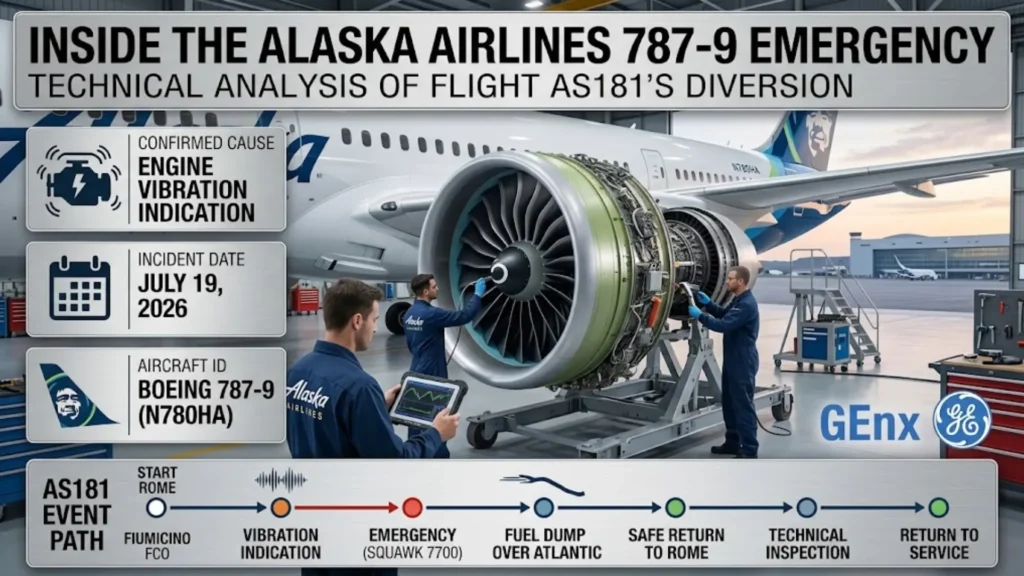
In the case of AS181, the confirmed public information supports describing the event as an engine-vibration indication or mechanical issue, rather than claiming that the engine failed.
Did Flight AS181 Declare an Emergency?
Yes.
Flight-tracking data showed the aircraft using the international emergency transponder code 7700 during the return toward Rome. Contemporary reporting also described the crew as declaring an emergency.
Squawk 7700 is used to alert air traffic controllers that an aircraft is experiencing a general emergency and may require priority assistance.
However, declaring an emergency does not automatically mean that an aircraft is moments away from crashing.
Pilots can declare an emergency when they have a serious mechanical or operational concern and want priority handling, additional coordination, or access to emergency services.
In AS181’s case, the crew had enough time and control to turn the aircraft around, descend, and return to its departure airport.
Where Was Flight AS181 When It Turned Around?
The Boeing 787-9 had crossed into the European portion of its route and was heading toward the Atlantic when it reversed course.
Incident reports place the aircraft around 30 nautical miles northwest of Newquay, England, when it was en route at FL340 and the crew decided to turn around because of the engine-vibration indication.
Other flight-tracking reports show the aircraft making a broad turn near the Atlantic approaches before returning east toward Europe.
The location of the aircraft was significant because AS181 was beginning a long Atlantic crossing. Returning to Rome allowed the crew to bring the aircraft back to its departure airport rather than continuing across the ocean with a suspected mechanical problem.
Why Did the Plane Dump Fuel?
Reports from the incident indicate that AS181 dumped fuel over the Atlantic before continuing back toward Rome.
Fuel dumping can be used when an aircraft needs to reduce its weight before landing.
A fully fueled widebody aircraft beginning a long-haul flight can weigh considerably more than it would near the end of the journey. If a serious issue requires an early return, reducing fuel may help bring the aircraft closer to an appropriate landing weight.
Fuel dumping is therefore not, by itself, evidence that the aircraft was about to crash.
In this incident, the reported fuel dump occurred over open water during the return toward Rome.
Was the Alaska Airlines Boeing 787-9 Damaged?
The available public reporting confirms that the aircraft experienced an engine-vibration indication and was taken out of normal service for inspection.
It does not establish a major structural failure or catastrophic engine damage.
The aircraft landed safely at Rome Fiumicino and was moved to a remote stand for technical evaluation.
The precise mechanical cause behind the vibration indication was not publicly established in the sources reviewed for this article.
For that reason, claims that the engine “exploded,” “failed completely,” or suffered another specific mechanical failure should not be presented as established facts without additional official evidence.
Did Anyone Get Hurt?
There were no reported injuries associated with the AS181 emergency in the available reporting.
The Boeing 787-9 returned safely to Rome and landed normally. Emergency services were reportedly placed on standby, which is a standard precaution when an aircraft declares an emergency.
The incident therefore resulted in a significant flight disruption but not a reported crash or passenger injury event.
What Happened After the Emergency Landing?
After landing in Rome, the aircraft remained on the ground for technical evaluation.
According to incident reporting, the Boeing 787-9 remained in Rome for approximately 18 hours before subsequently operating as AS9281 and reaching Seattle with a delay of about 24 hours.
This sequence indicates that the aircraft was eventually returned to service rather than permanently removed from Alaska Airlines’ fleet.
Flight-history records also show that N780HA continued operating Alaska Airlines flights after the July incident, including later international services.
Was Flight AS181 Cancelled?
The original AS181 flight did not continue to Seattle after returning to Rome.
The aircraft underwent inspection and the passengers’ onward transportation was arranged. Reporting on the incident indicates that a subsequent flight was used to transport the passengers to Seattle.
The incident therefore caused a substantial delay for passengers who had expected to complete the Rome-to-Seattle journey that day.
How Long Was the Flight in the Air?
Flight AS181 spent approximately five hours in the air before landing back at Rome Fiumicino, according to contemporary reports and flight-incident records.
That is unusually long for a flight that ultimately returned to its departure airport.
The extended duration was related to the aircraft’s location when the issue was identified, its return route, and the operational steps taken before landing.
What Aircraft Was Involved?
The aircraft involved was a Boeing 787-9 Dreamliner operated by Alaska Airlines.
Its registration was:
Flight-tracking data identifies N780HA as a Boeing 787-9 operated by Alaska Airlines.
The aircraft is part of Alaska Airlines’ long-haul widebody fleet used on international routes.
The Boeing 787 family is designed for long-distance operations and is widely used by airlines around the world.
Was This a Boeing 787-9 Crash?
No.
The aircraft did not crash.
It experienced a reported engine-vibration indication, the crew declared an emergency, the aircraft turned back toward Rome, and it landed safely.
This distinction is particularly important because online searches for the incident may produce dramatic headlines describing an “emergency” without making clear that the aircraft completed a controlled return and landing.
An emergency declaration means the crew needed additional assistance or priority handling. It does not necessarily mean the aircraft was uncontrollable.
Is the Boeing 787-9 Safe After This Incident?
One isolated mechanical incident cannot be used to determine whether an entire aircraft model is safe or unsafe.
Modern commercial aircraft are designed with multiple systems, redundancy, monitoring equipment, maintenance requirements, and procedures for dealing with abnormal conditions.
In this case, the crew responded to the engine-vibration indication by returning to a suitable airport rather than continuing across the Atlantic.
The aircraft was subsequently inspected and later appeared in Alaska Airlines flight-history records, indicating that it returned to operational service.
That does not mean every mechanical question surrounding the incident has been publicly explained. It simply means the available evidence does not support describing the aircraft as permanently grounded or destroyed.
What Does an Engine-Vibration Warning Mean?
Engine vibration can indicate that something within or around an engine is operating outside expected parameters.
Possible causes in aviation can vary significantly, including mechanical imbalance, component problems, sensor indications, or other issues.
However, it would be inappropriate to identify a specific failed component in AS181 without an official maintenance or investigation finding.
The information publicly associated with this flight establishes an engine-vibration indication, not a confirmed component failure.
For readers searching for the Alaska Airlines Boeing 787-9 emergency, this is one of the most important distinctions between verified information and speculation.
Why Didn’t the Plane Land at a Closer Airport?
One common question about the incident is why the crew returned all the way to Rome rather than landing at another European airport.
The aircraft had already turned back while over or near the Atlantic approaches and was operating under the crew’s assessment of the situation.
Pilots consider multiple factors when selecting a diversion airport, including:
- Aircraft condition
- Weather
- Runway availability
- Airport facilities
- Maintenance support
- Aircraft weight
- Fuel
- Passenger needs
- Air traffic conditions
- Distance and route
The available public reporting does not establish that Rome was selected for one specific reason.
Therefore, claims that the crew “should have landed” at a particular airport should be treated cautiously unless supported by official aviation findings.
What Did Passengers Experience?
Passengers experienced a major change to their travel plans after the aircraft turned around.
Contemporary reporting included passenger accounts describing the aircraft turning back and dumping fuel. One passenger told media that the crew informed travelers that fuel would need to be dumped before the return.
Passenger reports are useful for understanding what happened inside the cabin, but they should be distinguished from official information about the technical cause.
The airline’s confirmed operational response and the reported engine-vibration indication provide a more reliable basis for explaining the incident.
What Happened to Passengers After Returning to Rome?
Once AS181 returned to Rome, the passengers could not simply continue the original flight on the same aircraft immediately.
The aircraft required technical evaluation, and arrangements were made to get passengers to Seattle.
Incident reporting indicates that the aircraft eventually departed Rome on a later service and reached Seattle after the delay.
The exact arrangements for individual passengers may have differed depending on available flights and airline rebooking.
Has Alaska Airlines Flight AS181 Continued Operating?
Yes.
Alaska Airlines continues to operate Flight AS181 between Rome and Seattle.
The airline’s current flight-status pages show AS181 operating on the Rome-Seattle route after the July incident, while flight-history services show different Boeing 787-9 aircraft being assigned to the route over subsequent weeks.
For example, FlightRadar24 records show AS181 operating on multiple dates in September 2026 with Boeing 787-9 aircraft including N781HA, N782HA, N783HA, and N784HA.
This supports the conclusion that the July emergency was an isolated event affecting one particular aircraft and flight rather than a suspension of the entire Rome-Seattle service.
Alaska Airlines Boeing 787-9 Emergency Timeline
July 19, 2026
Alaska Airlines Flight AS181 departed Rome Fiumicino for Seattle aboard Boeing 787-9 N780HA.
During the Flight
The aircraft climbed toward its planned cruising altitude before the crew received an engine-vibration indication.
Return Toward Europe
The aircraft descended and reversed course toward Rome. Flight-tracking records and contemporary reports show the emergency transponder code 7700 being used.
Fuel Dump
The aircraft reportedly dumped fuel over the Atlantic while preparing to return to Rome.
Safe Landing
The Boeing 787-9 landed safely at Rome Fiumicino after approximately five hours in the air.
Technical Inspection
The aircraft was taken for engineering inspection following the return.
Later Return to Service
Incident reporting states that the aircraft later departed as AS9281 and reached Seattle after a significant delay.
Does This Incident Mean Alaska Airlines Has a Boeing 787 Problem?
There is not enough evidence to make that conclusion.
The incident involved one aircraft experiencing an engine-vibration indication during one flight.
A mechanical issue on one aircraft does not establish a fleet-wide defect, and the available public reports do not establish a broader Boeing 787-9 safety problem involving Alaska Airlines.
It is also important not to confuse an individual aircraft incident with broader discussions about Boeing aircraft safety.
Any determination that a specific recurring defect exists would require evidence from the airline, aircraft manufacturer, regulators, or a formal investigation.
What Is the Latest Update on the Aircraft?
The most useful current indicator is the aircraft’s subsequent operational history.
Flight-tracking data identifies N780HA as an Alaska Airlines Boeing 787-9 and shows the aircraft continuing to appear in Alaska Airlines operations after the July 19 incident.
Flight AS181 itself also continued operating between Rome and Seattle in the weeks and months after the emergency.
As of this article’s September 14, 2026 update, the available sources reviewed do not establish a later catastrophic event connected to the July 19 engine-vibration incident.
Frequently Asked Questions
What happened to Alaska Airlines Flight AS181?
Flight AS181 was flying from Rome to Seattle on July 19, 2026, when the Boeing 787-9 experienced an engine-vibration indication. The crew turned back toward Rome, declared an emergency, and landed safely.
Why did Alaska Airlines Flight AS181 return to Rome?
The aircraft returned because of an engine-vibration indication. Public incident records identify engine vibrations as the reason for the diversion.
Was the Alaska Airlines Boeing 787-9 damaged?
The aircraft underwent technical inspection after landing. Public reporting confirms the engine-vibration indication but does not establish a major structural failure or specific engine component failure.
Did Flight AS181 crash?
No. The aircraft returned safely to Rome Fiumicino and landed normally. There were no reported injuries.
Why did the Boeing 787-9 dump fuel?
The aircraft reportedly dumped fuel over the Atlantic while returning to Rome. Fuel dumping can reduce an aircraft’s weight before an early landing following a long-haul departure.
What was the aircraft registration?
The Boeing 787-9 involved in the incident was registered N780HA.
Did Alaska Airlines Flight AS181 continue operating afterward?
Yes. Flight-history records show AS181 continuing to operate the Rome-Seattle route after the July incident, using Boeing 787-9 aircraft.
Were there injuries on Flight AS181?
No injuries were reported in the available coverage of the incident. The aircraft landed safely in Rome.
Was the engine on the Boeing 787-9 shut down?
The available public reports reviewed for this article establish an engine-vibration indication, but they do not establish that the affected engine was shut down in flight. That detail should not be presented as confirmed without additional official documentation.
Conclusion
The Alaska Airlines Boeing 787-9 emergency involving Flight AS181 was a serious but safely managed aviation incident. On July 19, 2026, the Boeing 787-9 traveling from Rome to Seattle experienced an engine-vibration indication, prompting the crew to turn around, declare an emergency, and return to Rome.
The aircraft reportedly dumped fuel during the return and landed safely at Fiumicino after roughly five hours in the air. No injuries were reported, and the aircraft was subsequently inspected before returning to service.
The incident should not be described as a Boeing 787-9 crash or confirmed engine failure. The strongest publicly supported description is a mechanical issue involving an engine-vibration indication that led the crew to make a precautionary return to Rome.
Flight AS181 has continued operating between Rome and Seattle, showing that the July emergency did not permanently end the route. from Rome to Seattle