

A policy sitting quietly in government paperwork since February could reshape how much you pay for an imported phone in Pakistan. It has not been implemented yet, and it may never be in its current form, but understanding it now puts you ahead of anyone caught off guard if it goes through.
The Proposal in Plain Terms
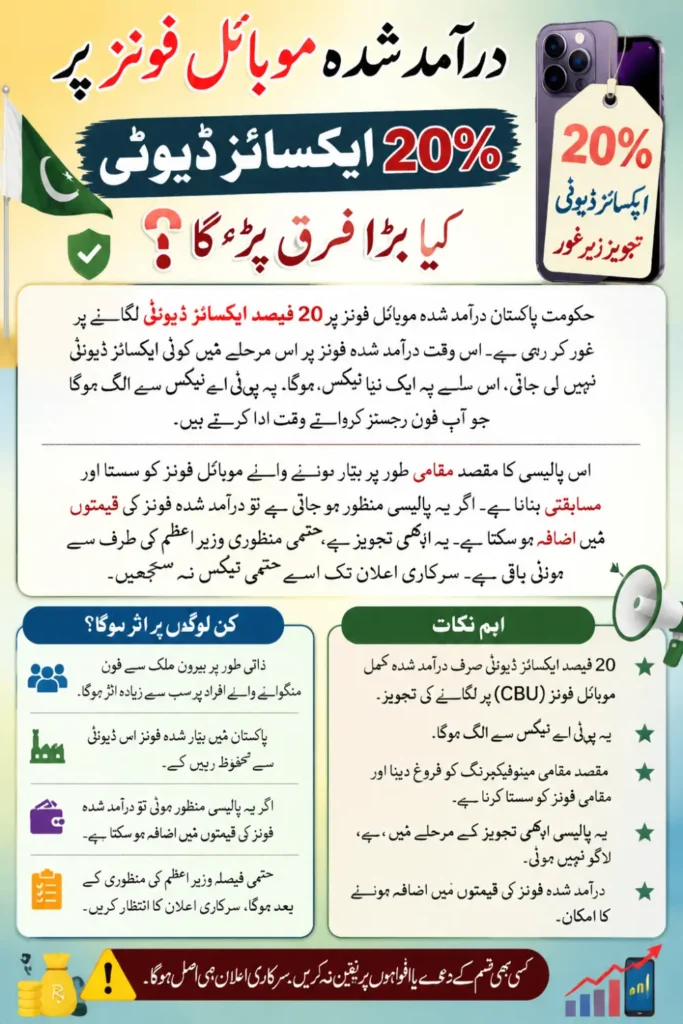
The federal government is weighing a 20 percent federal excise duty on completely built unit, or CBU, mobile phones brought into Pakistan. Right now, imported phones face zero federal excise duty at this stage of the supply chain, so this would be a genuinely new layer of taxation rather than an adjustment to an existing one.
This is separate from the PTA tax you already pay when registering a phone through DIRBS. If both apply, buyers of imported phones would be paying two distinct charges rather than one, on top of the standard GST and regulatory duty already baked into pricing.
Where This Idea Came From
The proposal sits inside a larger plan called the Mobile and Electronics Manufacturing Framework 2026-33, put together by the Engineering Development Board. The stated goal is not simply to raise revenue, but to make locally assembled phones more competitive against imports, particularly ones entering through the Pakistan-China Free Trade Agreement, which officials say has created pricing advantages for certain imported devices over locally made ones.
Alongside the phone duty, the same framework proposes a 10 percent customs duty on imported laptops, desktops, and tablets, plus a phased duty on completely knocked-down kits starting at 5 percent and rising to 10 percent over time.
Also Read: vivo X300 FE Launch in Pakistan – Price, Specs & Full Review
Who Is Actually Deciding This
The framework was finalized by the Engineering Development Board following a high-level meeting chaired by the Special Assistant to the Prime Minister on Industries, Haroon Akhtar Khan. Senior officials from the Ministry of Industries and Production, including the EDB’s chief executive, were part of the review. The finalized document is meant to go to Prime Minister Shehbaz Sharif for approval, meaning it is not yet law and would need sign-off before taking effect.
There is also a financial side to this push. The government is planning a Rs. 56 billion technology investment fund aimed at supporting local manufacturers of phones and other electronics, and officials have set a target of $400 million in annual revenue from re-exporting refurbished devices.
Also Read: Mobile Phone Prices Reduced in Pakistan – Latest 2026 Update
How This Differs From the Duty Cut You Might Have Heard About
If this sounds like it contradicts the mobile phone duty cut that took effect on July 1, 2026, that is because it does, in a sense, but the two apply to different things. The July 1 change reduced regulatory duty by 20 percent specifically on premium imported handsets, aimed at giving relief to buyers of expensive phones. This excise duty proposal, by contrast, is a completely new charge aimed at protecting local manufacturing rather than offering consumer relief.
Both policies can technically coexist. A flagship imported phone could see its regulatory duty reduced while simultaneously facing a brand new 20 percent excise duty, depending on how the final rules are written.
What Happens If It Is Approved
If the Prime Minister approves the framework as proposed, imported CBU phones would carry meaningfully higher upfront costs than they do today. Since this duty applies at the import stage rather than at PTA registration, it would likely show up as a higher retail price on the device itself, separate from whatever tax you pay later to activate it on a local network.
Locally assembled phones, which already dominate Pakistan’s market, would not be affected by this duty in the same way, since the policy is designed to make them more price-competitive rather than more expensive.
Also Read: Samsung Galaxy S26 Series Price in Pakistan (2026)
Timeline: Where Things Stand Right Now
This policy has been public since mid-February 2026, and as of late July, there has been no confirmed announcement that it has been signed into effect. Policies like this can move slowly through approval stages, get revised before implementation, or in some cases get shelved entirely if industry pushback is significant.
Buyers should treat this as a proposal worth watching rather than an active tax. If you see a retailer or a website claiming this duty is already being charged, verify it against an official FBR or Ministry of Industries notification before believing it.
Also Read: Honor X6e Launched With 7500mAh Battery – Pakistan Next?
What This Could Mean for Different Buyers
Someone importing a phone personally, whether through overseas relatives or online resellers, stands to feel this the most if it passes, since CBU imports are exactly what the duty targets. Buyers who purchase locally assembled phones from brands with Pakistan-based manufacturing would largely be shielded from this specific charge.
For anyone planning to buy an imported flagship in the near future, it may be worth keeping an eye on official updates before the policy potentially adds a new cost layer on top of existing PTA taxes.
Also Read: HMD Asha 305 Launched at $65 – Coming to Pakistan Soon?
Frequently Asked Questions
Has the 20 percent excise duty on imported phones been implemented yet?
No. As of late July 2026, this remains a proposed policy awaiting approval from the Prime Minister, and has not been confirmed as active.
Is this the same as PTA tax?
No. PTA tax is charged separately during device registration through DIRBS. This proposed excise duty would apply at the import stage, before a phone even reaches a buyer.
Why is the government considering this duty?
The stated reason is to make locally assembled mobile phones more price-competitive against imports, particularly those benefiting from the Pakistan-China Free Trade Agreement.
Will this duty apply to locally manufactured phones?
No. The policy specifically targets completely built unit, or CBU, imports rather than phones assembled inside Pakistan.
Does this duty affect laptops and tablets too?
The same framework proposes a separate 10 percent customs duty on imported laptops, desktops, and tablets, along with a phased duty on knocked-down kits.
Where can I check if this policy has been officially approved?
Official confirmation would come through an FBR notification or a statement from the Ministry of Industries and Production, so it is worth checking those sources directly rather than relying on secondhand claims.
Also Read: Samsung Galaxy Z Fold 8 Ultra & Flip 8 – Pakistan Price Guess